AI-Driven Predictive Maintenance
& HVAC Optimization
Transforming facility management from reactive firefighting to proactive intelligence
Traditional facilities management drowns engineers in alarm noise. At CBRE, I led the UX strategy to operationalize Ellis AI — a proprietary engine that reads thousands of IoT sensors, normalizes building system data, and surfaces only what matters. The result: a platform that reduced 70,000 monthly alarms to 1,400 actionable events, projecting $1.8M in cost avoidance across early-adopter clients.
Turning Alarm Noise Into Actionable Intelligence
Traditional facility management is driven by intuition and reactive responses. Building engineers are overwhelmed by thousands of redundant, low-priority alarms generated by BAS systems that have never been properly filtered. Critical HVAC failures go undetected until something breaks — costing time, money, and occupant comfort.
Principal UX Designer — End-to-End Ownership
I owned the full design lifecycle for SmartFM's AI-powered maintenance intelligence features — from stakeholder research through shipped production designs, embedded with product managers, Ellis AI engineers, and facility management domain experts.
Four AI-Enabled Design Breakthroughs
Operationalizing Ellis AI required translating opaque machine-learning outputs into experiences that facility engineers could trust, act on, and override. Each feature below represents a distinct design challenge in human-AI collaboration.
Predictive Maintenance Logic
Instead of fixed maintenance schedules, I designed the UX for condition-based maintenance
— where Ellis AI analyzes real-time IoT sensor data and historical issue patterns to predict failures
before they happen.
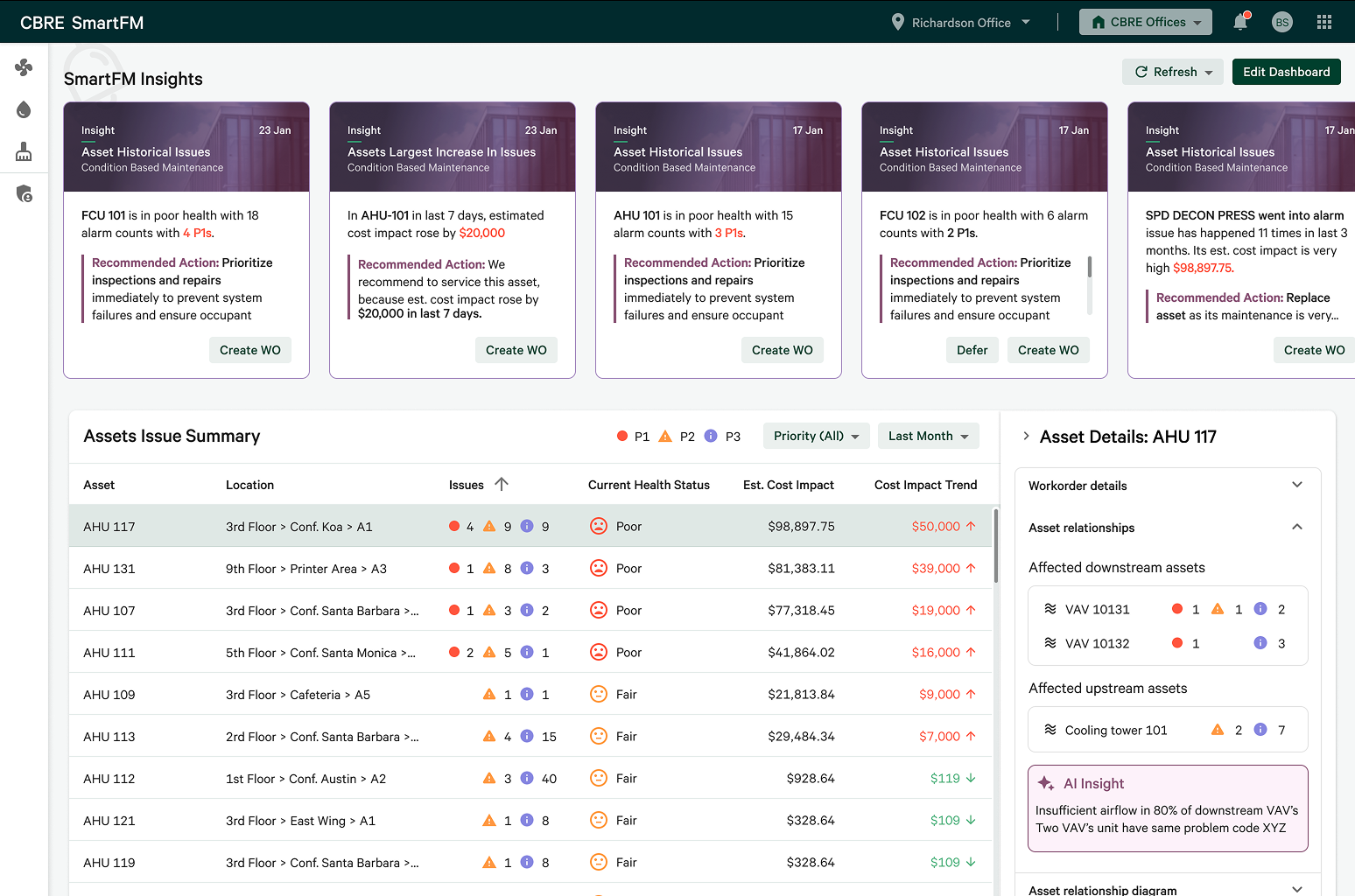
The SmartFM Insights dashboard surfaces assets ranked by health score, estimated cost impact,
and cost trend — giving engineers a prioritized action queue. The AI insight card provides
root-cause context: not just "AHU 101 has issues" but "Insufficient airflow in 80% of downstream
VAVs — two VAV units share problem code XYZ."
Key design decision: cost impact made visible at asset level. Showing $98,897 alongside
AHU 117 transforms a technical alert into a business decision.
Smart HVAC Insight Cards
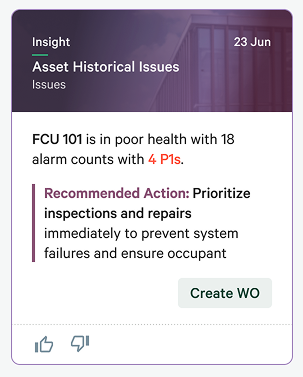
The core design challenge: how do you communicate why the AI flagged an asset,
not just that it did? An alert without context creates hesitation; context creates action.
I designed the Insight Card system — proactive cards that surface specific, machine-generated
explanations with Recommended Actions and a direct "Create Work Order" CTA,
collapsing the distance between insight and response to a single click.
Ellis AI Explanation Panel
The biggest barrier to AI adoption in enterprise operations is trust.
If engineers don't understand why the system flagged an asset, they ignore the alert.
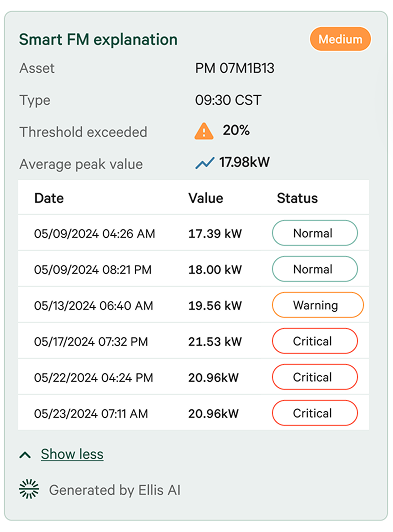
I designed the Ellis AI Explanation Panel — a side panel showing the exact
asset ID, the specific threshold exceeded, and a historical date-value trend
that proves the system's "Warning" or "Critical" rating with real sensor data.
This transparency layer — showing the reasoning chain, not just the conclusion — was the
critical trust-building decision that drove engineer adoption.
Automated Issue Triage & Remote Resolution
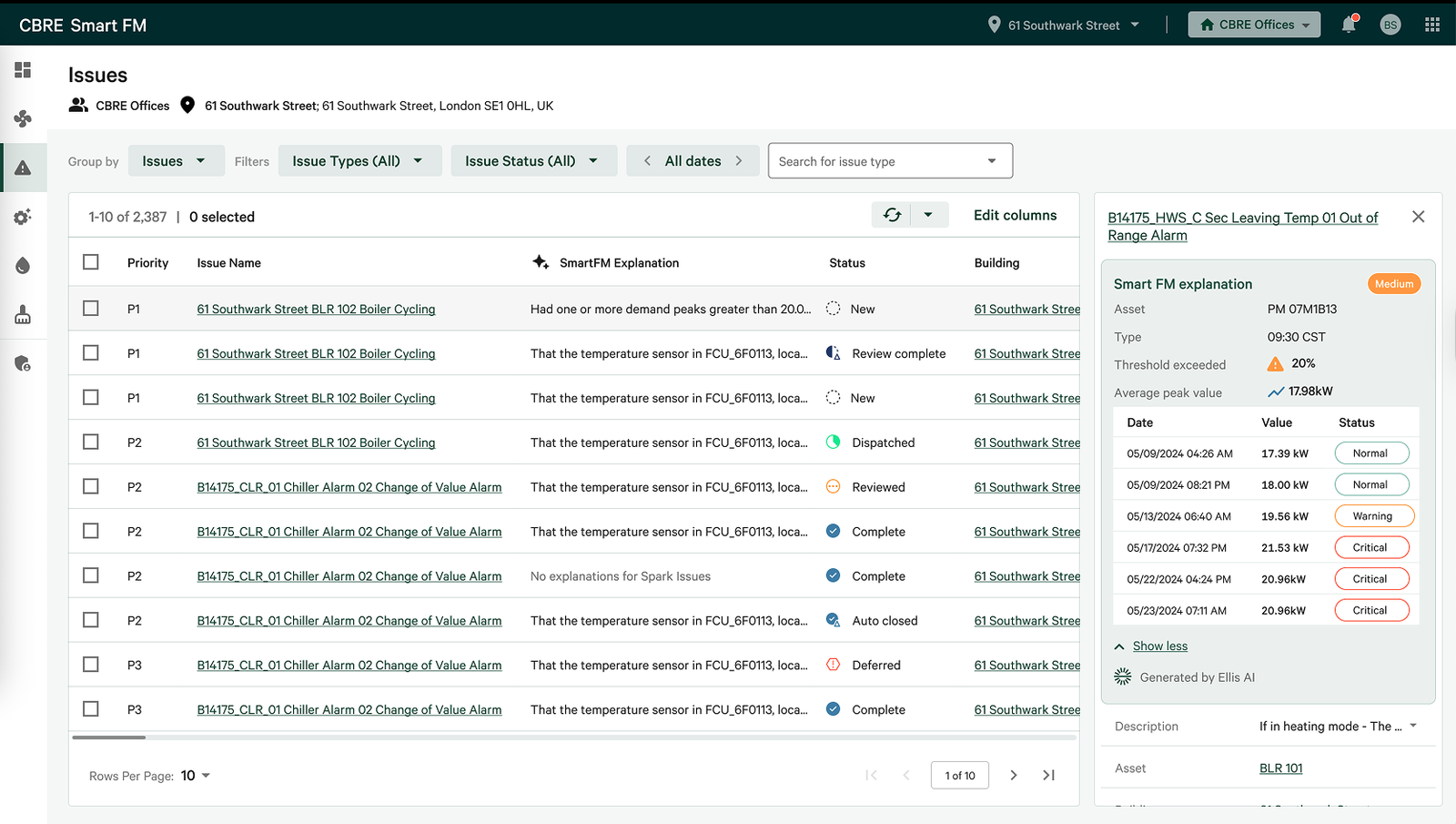
I designed the automation handoff layer — the moment where the system acts
autonomously vs. when it surfaces a recommendation for human review.
Issue lifecycle states: New → Reviewed → Dispatched → Auto-closed.
"Auto-closed" represents issues resolved remotely through software adjustments without dispatch.
The SmartFM Explanation for every auto-closed event maintains a complete, human-readable audit trail
— making automation visible and trustworthy.
Think · Make · Check
I utilized an iterative cycle to ensure Ellis AI's logic aligned with the mental models of Facility Managers, ROC Engineers, and Account Leads — three user types with fundamentally different needs from the same platform.
Measurable Results Across the Portfolio
Every design decision was validated against business metrics, adoption data, and direct user feedback from Facility Managers and Remote Operations Centers globally.